


 English
 中文
中文

When a wire and cable manufacturer is looking for an extrusion line, the real question is not simply how large the extruder is or how fast the line can run. What matters more is whether the whole production system can work steadily, whether the material is fed smoothly, whether the extrusion process is easy to control, and whether the finished product can keep a consistent shape over a long production period.
That is exactly how I look at the 80+120 High-efficiency Frame Empty Line Extrusion Production Line. I do not treat it as just a combination of machines. I see it as a complete production system in which feeding, extrusion, forming, cooling, traction, and take-up need to work together. If one part is poorly matched, the operator will feel it sooner or later in the form of unstable dimensions, material waste, frequent adjustments, or unnecessary downtime.
At Wuxi Shuochuan Electromechanical Equipment Manufacturing Co., Ltd., we develop and manufacture extrusion equipment with a practical approach. Our work covers high-speed extruders, automatic BV and BVVB extrusion Production Lines, photovoltaic wire and Cable Production lines, automotive Wire Production lines, electronic Wire Production Lines, network communication cable lines, charging pile Cable Production Lines, take-up and unwinding equipment, and related Auxiliary Equipment.
For the 80+120 High-efficiency Frame Empty Line Extrusion Production Line, my focus is simple: build a coordinated line that can provide stable extrusion processing, practical operation, and a configuration that matches the customer's actual product and production plan.
1. What Is the 80+120 High-efficiency Frame Empty Line Extrusion Production Line?
The name itself contains several useful pieces of information. “80+120” generally indicates a production line equipped with two extrusion units of different nominal sizes. However, I would not suggest judging the complete line only from these numbers. The actual function of each extruder depends on the product structure, insulation or sheath material, layer arrangement, required output, die design, and process conditions.
“Frame empty line” refers to the intended production configuration rather than a single universal cable specification. In practical engineering, we first need to understand exactly what the customer means by frame empty line, what product is being produced, and how the extrusion layers are arranged. This is important because the same basic extrusion platform can be configured differently for different products.
“High-efficiency” is also not simply a claim about running speed. In my view, an efficient extrusion line should make good use of raw materials, reduce unnecessary adjustment, maintain stable processing, simplify operation, and keep the downstream equipment working in coordination with the extruder.
A typical extrusion process can be understood quite simply:
Raw material is prepared and supplied to the feeding system.
The extruder conveys and plasticizes the material.
The molten material passes through the extrusion die.
The material forms around or over the required product structure.
The extruded product enters the cooling section.
The traction system maintains a controlled production speed.
The finished product is collected by the take-up system.
It sounds straightforward, but stable extrusion depends on how these stages interact. A good 80+120 Extrusion Production Line therefore needs more than two extruders. It needs suitable auxiliary equipment, sensible layout, process control, and proper commissioning.
2. How the Extrusion Production Process Works
When I explain an extrusion line to a new customer, I usually avoid starting with complicated technical terms. The easiest way to understand the machine is to follow the material from the beginning to the finished cable.
Material Feeding
The process starts with raw material feeding. Depending on the product, different thermoplastic or other extrusion materials may be required. Common cable-related materials can include PVC, PE, PP, and cross-linked compounds, but the correct material depends entirely on the customer's product design.
Stable feeding is important because an uneven material supply can make the extrusion process unstable. The operator may then see changes in pressure, product dimensions, surface quality, or output.
Plasticizing and Extrusion
Inside the extruder, the screw conveys and plasticizes the material. Heat and mechanical shear work together to turn the material into a controlled melt. The material then moves toward the extrusion die.
This is one of the areas where practical experience matters. A theoretical machine specification does not automatically mean that every material will run in the same way. Screw design, material characteristics, temperature settings, die structure, line speed, and cooling conditions all affect the final result.
Die Forming
The extrusion die gives the molten material its required shape. For wire and cable production, the die must be selected according to the conductor, insulation structure, outer diaMeter, material, and product requirements.
Small changes in die alignment can have a noticeable effect on product quality. That is why die installation and adjustment are important parts of commissioning.
Cooling and Sizing
After forming, the hot extruded material enters the cooling section. Cooling needs to be controlled carefully. Cooling too quickly or unevenly can affect dimensional stability, while insufficient cooling can make downstream traction more difficult.
For this reason, I always consider the extrusion section and cooling section as one process rather than two completely separate machines.
Traction and Take-up
The traction unit pulls the product through the line at a controlled speed. The take-up system then collects the finished product in an organized manner.
If extrusion speed and traction speed do not match properly, product dimensions can change. The take-up system also needs to maintain suitable tension so that the finished wire or cable can be collected without unnecessary deformation or winding problems.
3. Main Features of Our 80+120 High-efficiency Extrusion Line
I believe the biggest value of this production line is not one isolated component. It is the coordination of the complete system.
Two Extrusion Units for Flexible Production Configuration
The 80+120 configuration provides two extrusion units with different nominal sizes. This gives the production line more flexibility for products requiring coordinated extrusion processes.
The exact role of each extruder should be determined during the technical design stage. We consider the customer's product structure, material characteristics, target production capacity, layer requirements, and operating conditions before confirming the configuration.
Continuous Production
Wire and cable production is normally a continuous process. Frequent stopping and restarting can create material waste and make process control more difficult.
Our high-efficiency frame empty line extrusion production line is designed around continuous operation. Feeding, extrusion, cooling, traction, and take-up are coordinated so that the operator can manage the line as one production system.
Controlled Extrusion
Extrusion needs stable temperature, material flow, screw operation, and die conditions. The control system is therefore an important part of the complete equipment configuration.
Rather than adding unnecessary controls, we focus on controls that help operators understand the production status and make practical adjustments.
Practical Operation
Industrial equipment should not be difficult to operate simply because it contains more technology. In our view, the operator should be able to understand the main operating parameters, identify abnormal conditions, and make normal production adjustments without wasting time.
Adaptable Configuration
Not every customer produces the same wire or cable. For this reason, we do not regard one fixed configuration as suitable for every project.
We can discuss the product specification, material, production capacity, equipment layout, auxiliary equipment, and delivery requirements before production. This allows the final extrusion line to be designed around the actual manufacturing task.
4. Technical Points I Check Before Designing the Line
One of the easiest mistakes when purchasing an extrusion machine is to start with price before defining the production requirements. I prefer to start with the product.
Before confirming an 80+120 extrusion production line, I would normally look at several basic questions.
| Item | What We Need to Confirm | Why It Matters |
|---|---|---|
| Product structure | Conductor, insulation, sheath, layer arrangement | Determines extrusion configuration and die requirements |
| Material | PVC, PE, PP, cross-linked compounds, or other materials | Different materials require different processing conditions |
| Product dimensions | Conductor size and finished product dimensions | Influences die, cooling, traction, and process settings |
| Production target | Required output and operating schedule | Helps determine suitable line configuration |
| Factory layout | Available installation space and line direction | Allows practical equipment arrangement |
| Automation requirements | Manual, semi-automatic, or automatic operation | Affects control and auxiliary equipment selection |
These points may sound basic, but they prevent many problems later. A production line is a complete system. If the customer's product requirements are unclear at the beginning, even a well-made machine may not deliver the expected result.
Why Material Matters So Much
Different extrusion materials behave differently during heating, melting, flowing, and cooling. For example, PVC, PE, PP, and cross-linked materials cannot simply be treated as interchangeable.
The IEC's cable test standards also distinguish different material-related requirements. IEC 60811-201 provides methods for measuring insulation thickness for common insulating compounds including cross-linked materials, PVC, PE, and PP.
For sheath thickness, IEC 60811-202 provides corresponding measurement methods for common sheathing compounds such as cross-linked materials, PVC, PE, and PP.
This is why I always ask about the exact material before discussing detailed process parameters.
5. Product Quality: What Should a Buyer Actually Look At?
When customers compare two extrusion production lines, they often focus on motor power, machine size, or quoted output. These numbers are useful, but they are not enough.
From my experience, a better comparison includes the complete production process.
| Evaluation Area | What to Check | Practical Production Impact |
|---|---|---|
| Extrusion stability | Material feeding, temperature control, melt flow | Helps maintain consistent product forming |
| Dimensional control | Die alignment, cooling, traction | Helps maintain target product dimensions |
| Line coordination | Extruder, cooling, traction, take-up matching | Reduces unnecessary production adjustment |
| Operator interface | Control layout and parameter visibility | Makes daily operation easier |
| Maintenance | Access to components and routine inspection points | Helps reduce maintenance difficulty |
| Configuration flexibility | Material, product, and auxiliary equipment compatibility | Supports different production requirements |
The important point is that an extrusion line does not manufacture quality by itself. The final product also depends on conductor preparation, raw material quality, die design, process settings, operator experience, cooling conditions, and inspection.
For example, IEC 60228:2023 defines nominal conductor cross-sectional areas from 0.5 mm² to 3,500 mm² for a wide range of electric power cables and cords, together with requirements related to wire numbers, sizes, and resistance values.
This illustrates an important point for buyers: the extrusion line is one part of the cable manufacturing process. Finished-product compliance must be evaluated against the applicable product standard and testing requirements, rather than assumed simply because the machine is described as a cable extrusion line.
6. Where Can This 80+120 Extrusion Production Line Be Used?
The production line can be configured for a range of extrusion-related applications. The exact application depends on the final product design and confirmed process requirements.
Wire and Cable Manufacturing
Wire and cable production is one of the main application areas. The extrusion system can be configured for insulation or other extrusion processes according to the cable structure.
For manufacturers producing multiple cable categories, a flexible production line can be more useful than a machine designed around only one narrow product.
Photovoltaic Cable Production
Photovoltaic cable production has specific material and performance requirements. IEC 62930:2017 covers certain single-core cross-linked insulated power cables with cross-linked sheath for the DC side of photovoltaic systems, with a rated DC voltage up to and including 1.5 kV.
For this type of application, extrusion process control is important because insulation and sheath consistency directly affect the finished cable.
Automotive Wire
Automotive wires often require consistent dimensions, reliable insulation, and stable continuous production. The actual material and product specification determine the appropriate extrusion configuration.
Electronic Wire
Electronic wire applications can involve smaller product dimensions and different insulation requirements. In such cases, stable feeding, accurate die design, cooling control, and traction are especially important.
Network Communication Cable
Network communication products require careful control of product structure and dimensions. It is worth noting that IEC 60228:2023 specifically does not apply to conductors for telecommunication purposes, so the applicable product standards should always be confirmed separately for communication cable applications.
Charging Pile Cable
As electric vehicle charging infrastructure continues to develop, manufacturers need cable production equipment that can handle the required material and product structures. Our extrusion equipment can be configured around the customer's charging cable specifications and production requirements.
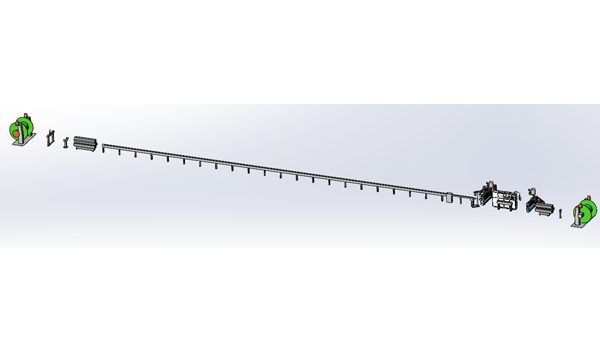
7. How We Manufacture and Deliver the Production Line
For a complete industrial extrusion line, manufacturing quality is not only about making individual components. Assembly, wiring, control integration, testing, and final inspection all matter.
Step 1: Confirm the Customer's Product
Before production begins, we discuss the product specification, material requirements, production capacity, equipment configuration, factory layout, and delivery schedule.
This stage is important because it allows us to identify possible technical issues before the equipment is manufactured.
Step 2: Confirm the Line Configuration
We then determine the appropriate extrusion units and supporting equipment. Depending on the project, this may include feeding systems, extrusion units, dies, cooling equipment, traction equipment, take-up equipment, electrical controls, and other auxiliary components.
Step 3: Equipment Manufacturing and Assembly
Individual components are manufactured and assembled according to the agreed design. Mechanical assembly and electrical integration need to work together because a production line is both a mechanical system and a control system.
Step 4: Testing Before Shipment
Before shipment, the complete production line is assembled, tested, and inspected according to the agreed requirements. This gives us an opportunity to identify assembly or control problems before the equipment reaches the customer's factory.
Step 5: Packaging and Transportation
Industrial extrusion equipment can contain large and sensitive components, so transportation protection matters. We normally use moisture-resistant materials, protective cushioning, and strong export wooden cases or pallets according to the equipment and shipping requirements.
| Delivery Stage | Our Main Work | Customer Benefit |
|---|---|---|
| Technical confirmation | Review product and production requirements | Reduces configuration misunderstandings |
| Production | Manufacture and assemble equipment | Builds the complete production system |
| Testing | Assembly, electrical and functional inspection | Helps identify issues before shipment |
| Packaging | Moisture protection and protective packing | Improves protection during transportation |
| Delivery | Sea, air, or land transportation arrangements | Supports different destination requirements |
8. Why Work With Wuxi Shuochuan?
There are many companies that can supply an extruder. For me, the difference is in how the supplier handles the complete project.
Wuxi Shuochuan Electromechanical Equipment Manufacturing Co., Ltd. integrates R&D, manufacturing, and sales. The company has obtained more than ten utility model patent certificates and has developed a range of automated equipment focused on efficient processing, energy saving, and practical operation.
The company states that it has passed ISO 19001 quality management system certification. For procurement documentation, customers should verify the exact certification number and applicable certificate directly during the qualification process.
Our product range covers much more than one extrusion model. We manufacture high-speed extruders, three-in-one BV Automatic Extrusion Production Lines, three-in-one plus one BVVB automatic production lines, photovoltaic wire and cable production lines, automotive wire production lines, electronic wire production lines, network communication cable lines, charging pile cable production lines, take-up and unwinding equipment, and related auxiliary products.
This broader product range is useful because extrusion equipment rarely works alone. A customer may need to connect the extruder with other production equipment, and understanding the complete process helps us discuss the project more realistically.
Our working principle is reflected in a simple phrase: Quality First, Continuous Improvement, and Honest Service. We would rather clarify a technical requirement before production than make a quick promise that later creates trouble for both sides.
9. What Buyers Should Confirm Before Ordering
If you are considering an 80+120 High-efficiency Frame Empty Line Extrusion Production Line, I recommend preparing the following information before requesting a quotation.
Product name and application
Conductor type and size
Required insulation or sheath structure
Raw material type
Target finished-product dimensions
Required production capacity
Expected operating schedule
Required automation level
Available factory space
Power supply conditions
Preferred line layout
Destination country and transportation requirements
The more complete this information is, the easier it is to design a suitable line. It also makes quotations easier to compare because different suppliers are working from the same technical requirements.
10. Frequently Asked Questions
What does 80+120 mean in this extrusion production line?
It generally indicates two extrusion units with different nominal sizes, 80 and 120. However, the exact function of each extruder depends on the product structure and process design. The numbers should not be treated as a complete specification of the finished production line.
What products can the 80+120 extrusion production line manufacture?
The line can be configured for wire and cable extrusion applications, including certain photovoltaic cables, automotive wires, electronic wires, communication-related products, charging cables, and other extrusion products. The actual product range depends on material, dimensions, die design, process conditions, and the final equipment configuration.
Can the production line be customized?
Yes. We normally confirm the customer's product specifications, material requirements, production capacity, equipment configuration, factory layout, and delivery requirements before production. The final configuration can therefore be designed around the actual manufacturing process.
What materials can be processed?
The suitable material depends on the product and extrusion process. Common cable extrusion materials can include PVC, PE, PP, and various cross-linked compounds. We need to confirm the exact material before selecting process-related components and configuration.
How long is the production lead time?
Lead time normally depends on the extruder model, complete line configuration, customization requirements, and order quantity. We confirm the expected delivery schedule during the technical and commercial discussion before production.
How is the production line tested before shipment?
Before shipment, the complete production line is assembled, tested, and inspected according to the agreed requirements. The purpose is to check the integration of the equipment and identify problems before the line is delivered to the customer.
How is the equipment packaged for export?
We normally use moisture-resistant materials, protective cushioning, and strong export wooden cases or pallets according to the equipment type and transportation requirements. The packaging is intended to protect the equipment during loading, handling, storage, and long-distance transportation.
Can the line be used for photovoltaic cable production?
It can be configured for photovoltaic cable extrusion applications, provided that the product specification and material requirements are compatible with the proposed line. For example, IEC 62930:2017 covers certain 1.5 kV DC photovoltaic cables using cross-linked insulation and sheath. The finished product must still be designed and tested against the applicable cable standard.
Does the extrusion line itself guarantee cable standard compliance?
No. This is an important distinction. The machine provides the production process, but finished-product compliance depends on the complete manufacturing process, raw materials, conductor quality, die and process settings, testing, and the applicable product standard. A production line should therefore be viewed as production equipment, not as automatic certification of the finished cable.
11. Final Thoughts on the 80+120 High-efficiency Frame Empty Line
After years of working around industrial equipment, I have found that a good production line is rarely about one impressive number. It is about whether the equipment works reliably on an ordinary production day.
The 80+120 High-efficiency Frame Empty Line Extrusion Production Line is designed around this idea. Its two-extruder configuration provides a flexible foundation for coordinated extrusion processing, while the feeding, extrusion, forming, cooling, traction, and take-up sections work together as a complete production system.
For wire and cable manufacturers, this matters because production consistency is often more valuable than simply chasing maximum speed. Stable material feeding, controlled extrusion, consistent forming, proper cooling, and coordinated take-up can make everyday production easier to manage and can help reduce avoidable waste and adjustment.
At the same time, I would always recommend choosing the line according to the actual product rather than choosing a model first and trying to fit the product afterward. The 80+120 configuration is a starting point. The final technical solution should be based on material, cable structure, dimensions, output requirements, auxiliary equipment, factory conditions, and applicable standards.
At Wuxi Shuochuan, we take this project-based approach from the first technical discussion through manufacturing, assembly, testing, packaging, and delivery. Our goal is not simply to supply an extrusion machine. We aim to provide a practical wire and Cable Extrusion Production Line that fits the customer's real production process.
If you are planning a new 80+120 high-efficiency extrusion line or replacing an existing cable extrusion system, the best starting point is to share the product structure, material, target dimensions, production capacity, and factory conditions. From there, the line configuration can be discussed on real production requirements rather than assumptions.
Technical Reference Sources
IEC 60228:2023 — Conductors of insulated cables. The standard specifies nominal conductor cross-sectional areas and related conductor requirements for a wide range of electric power cables and cords.
IEC 60811-201:2012+AMD1:2017+AMD2:2023 — Measurement of insulation thickness for common non-metallic insulating compounds, including cross-linked materials, PVC, PE, and PP.
IEC 60811-202:2012+AMD1:2017+AMD2:2023 — Measurement of non-metallic sheath thickness for common sheathing compounds, including cross-linked materials, PVC, PE, and PP.
IEC 62930:2017 — Electric cables for photovoltaic systems with a voltage rating of 1.5 kV DC, covering specified single-core cross-linked insulated power cables with cross-linked sheath for photovoltaic system DC applications.
Note: The standards listed above are technical references for cable design, testing, and product evaluation. They should not be interpreted as certification of this extrusion production line or of any finished cable manufactured on it.



 WhatsApp
 телефон