


 English
 中文
中文

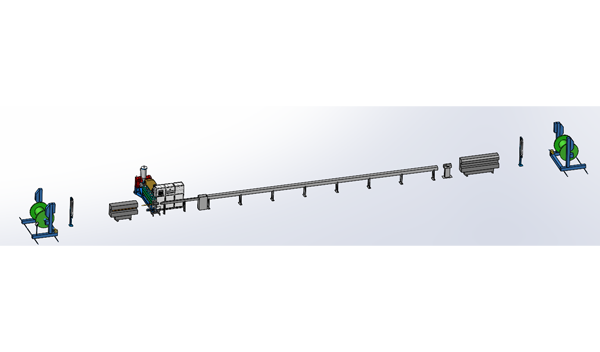
When we talk about a 120 High Pressure Extrusion Production Line, we are not simply talking about an extruder with a larger barrel. For us, a complete extrusion line is a working system. The extruder, feeding unit, die, cooling section, traction unit, take-up system, electrical controls, and supporting equipment all need to work together.
In wire and cable manufacturing, small changes in temperature, feeding, pressure, speed, or cooling can affect the finished product. That is why we focus on the whole Production Process rather than one machine alone. Our goal is to help customers build a stable extrusion process that is easy to operate, maintain, adjust, and expand when production requirements change.
The 120 High Pressure Extrusion Production Line is designed for continuous extrusion applications where stable material processing and controlled product forming are important. Depending on the customer's product, material, production capacity, and factory layout, the line can be configured for different wire and cable applications.
We work with manufacturers producing electrical wires, power-related cables, photovoltaic cables, automotive wires, electronic wires, communication cables, charging pile cables, and other extruded products. Before production, we confirm the product requirements and line configuration with the customer. This step may sound simple, but it is one of the most important parts of building a useful extrusion production line.
1. What Is a 120 High Pressure Extrusion Production Line?
In simple terms, an extrusion production line takes solid raw material, melts and processes it, and then forms it continuously around or onto the required product. Instead of making one piece at a time, extrusion allows manufacturers to produce long lengths of material in a continuous process.
The number “120” normally identifies the nominal size of the extrusion unit. However, the actual production capability should never be judged from the number alone. Material type, screw design, die structure, product size, extrusion temperature, line speed, cooling conditions, and other process settings all affect the final result.
The term “high pressure” is also important. It describes an extrusion process intended to provide controlled material flow under relatively demanding extrusion conditions. The actual pressure range is not a universal fixed value. It depends on the material being processed, screw and barrel design, die resistance, temperature settings, output requirements, and product structure.
That is why we do not recommend choosing an extrusion line simply by comparing the model number or nominal extruder size. A line that works well for one material may need a different configuration for another material.
For a real production project, we normally look at several questions first:
What product will be produced?
What material will be extruded?
What is the required product diaMeter or cross-section?
What production speed is expected?
What level of automation is required?
How much floor space is available?
What cooling and environmental conditions are available?
What testing or inspection requirements apply to the finished product?
Once these points are clear, we can work backward and determine the suitable extrusion equipment configuration.
2. How Does the 120 High Pressure Extrusion Line Work?
The working principle is easier to understand if we look at the line step by step. The production process starts with material preparation and feeding. The selected polymer or other extrusion material enters the feeding system and is delivered into the extruder in a controlled way.
Inside the extruder, the screw moves the material forward. At the same time, heat and mechanical energy help soften or melt the material. The screw geometry and process settings affect how the material is mixed, plasticized, pressurized, and transported.
The processed material then moves toward the die. The die gives the material its required shape. In cable manufacturing, the die may be used to apply an insulation or sheath layer around a conductor or another cable component.
After leaving the die, the newly formed product normally enters a cooling section. Cooling changes the material from a soft, newly formed state into a more stable shape. The cooling process needs to match the material and product requirements. Cooling too quickly, too slowly, or unevenly can create production problems.
The product then passes through a traction system. The traction unit controls the movement of the product through the production line. Its speed needs to be coordinated with extrusion output and other line sections.
Finally, the product reaches the take-up system, where the finished wire or cable is collected in a controlled manner.
| Production Stage | Main Purpose | Typical Process Concern |
|---|---|---|
| Material Feeding | Provide stable material supply | Feeding consistency and material preparation |
| Extrusion | Heat, plasticize and transport material | Temperature, screw condition and pressure |
| Die Forming | Shape the extruded material | Die design and dimensional control |
| Cooling | Stabilize the formed product | Cooling temperature and uniformity |
| Traction | Move product through the line | Speed coordination and tension |
| Take-Up | Collect finished wire or cable | Winding tension and alignment |
Source note: The table describes the general extrusion process structure used in industrial wire and Cable Production. Exact equipment configuration depends on the product and customer requirements. IEC 60502-1:2021 provides construction, dimensional, and testing requirements for certain power cables with extruded solid insulation; it does not prescribe one specific extrusion machine configuration. See technical references below.
This coordinated process is where a complete 120 High Pressure Extrusion Production Line becomes more useful than an individual extrusion machine. Every section affects the next one.
3. Main Features We Focus On
Stable Continuous Extrusion
Continuous production is one of the main reasons manufacturers invest in an extrusion line. Once the process is properly adjusted, the equipment can continue producing long lengths of product without repeated manual forming operations.
For us, stable extrusion means more than simply keeping the machine running. Material feeding, temperature control, extrusion output, product forming, cooling, traction, and take-up should remain coordinated during production.
Controlled Material Feeding
Feeding is easy to overlook, especially when people focus only on the extruder. But unstable feeding can affect output and product consistency. We therefore treat the feeding system as an important part of the complete line.
Depending on the material and process, different feeding arrangements may be considered. The final choice is made according to the material characteristics and production requirements rather than using the same setup for every customer.
Practical Process Control
A modern production line should not make operators fight with the machine every day. We aim for a control system that allows operators to monitor important operating conditions and make necessary adjustments without unnecessary complexity.
Temperature, speed, extrusion conditions, traction, and take-up are among the areas that need coordinated control. The exact control functions depend on the final equipment configuration.
Coordinated Cooling and Traction
After extrusion, the product needs to maintain its intended shape while passing through the cooling and traction sections. If the line speed and extrusion output are not properly matched, dimensional problems can occur.
We therefore consider cooling and traction as part of the extrusion process rather than as separate machines placed after the extruder.
Flexible Configuration
Not every wire and cable manufacturer produces the same products. Some customers focus on photovoltaic cables, while others manufacture automotive wires, electronic wires, communication cables, or charging cables.
For this reason, we configure the line around the customer's product instead of forcing every project into one fixed arrangement.
4. Technical Advantages for Wire and Cable Production
The biggest technical advantage of a properly configured 120 High Pressure Extrusion Production Line is process coordination. A good extrusion line should make it easier to keep the main production variables under control.
One important variable is temperature. Different materials have different processing windows. The barrel, die, and other heating areas need suitable temperature settings. Operators also need to watch whether the actual temperature remains stable during production.
Another important factor is extrusion pressure. Pressure is affected by the material, screw, die, temperature, and production conditions. We do not treat one pressure value as suitable for every application. Instead, process conditions should be established during commissioning and production trials.
Screw design is another technical consideration. The screw is responsible for conveying and processing the material inside the barrel. Its geometry can influence plasticization, mixing, output, and material residence behavior. For this reason, screw selection should be related to the actual extrusion material and product.
The die is equally important. Even when the extruder itself is working normally, an unsuitable die can lead to poor forming or unstable dimensions. For wire and cable applications, the die must be selected according to conductor size, insulation or sheath material, product dimensions, and process requirements.
Cooling is also closely related to product quality. After the material leaves the die, it must be cooled in a controlled way. The goal is to stabilize the shape without creating unnecessary stress or deformation.
Finally, the traction and take-up sections affect the way the finished product is handled. Stable pulling and winding help maintain a controlled production process from the extrusion head to the finished coil.
| Process Factor | Why It Matters | What We Consider |
|---|---|---|
| Material | Different materials process differently | Melting behavior, flow characteristics and processing requirements |
| Temperature | Influences melting and material flow | Suitable temperature settings for each processing zone |
| Pressure | Reflects resistance and material flow conditions | Material, die, screw and process settings |
| Screw | Controls material conveying and plasticizing | Material type and required output |
| Die | Determines product forming | Product structure and dimensions |
| Cooling | Stabilizes the formed product | Cooling method and process conditions |
| Traction | Controls product movement | Line speed, tension and extrusion output |
Source note: These are practical engineering considerations rather than fixed performance claims for every 120 High Pressure Extrusion Production Line. Actual values and configuration must be confirmed through product and material trials.
5. Applications of the 120 High Pressure Extrusion Production Line
Our extrusion equipment is intended for a wide range of wire, cable, and extrusion-related applications. The exact configuration depends on the product being manufactured.
Photovoltaic Cable Production
Photovoltaic cable production requires controlled insulation and sheath processing. The extrusion system needs to maintain stable material flow and product dimensions over continuous production.
For photovoltaic cable manufacturers, we can design the production line around the required cable structure, material, production capacity, and factory layout.
Automotive Wire Manufacturing
Automotive wires often have relatively compact dimensions and may require stable insulation thickness and consistent surface quality. A well-coordinated extrusion line helps manufacturers keep the process stable over long production runs.
Electronic Wire Production
Electronic wires can involve smaller product dimensions and specific insulation materials. In such applications, stable extrusion output, die selection, cooling, and take-up control become particularly important.
Network Communication Cable
Communication cable manufacturing requires attention to product geometry and material consistency. Depending on the cable design, extrusion equipment may be used for insulation or protective layers.
Charging Pile Cable
As charging infrastructure continues to develop, cable manufacturers need production equipment that can handle continuous extrusion processes for charging cable products. The line configuration should be selected according to conductor structure, insulation material, sheath material, product dimensions, and required capacity.
General Wire and Cable Applications
Beyond the applications above, extrusion equipment can be used for many other industrial wire and cable products. We can discuss the product structure and processing material with the customer before selecting the equipment configuration.
| Application | Typical Extrusion Role | Key Production Focus |
|---|---|---|
| Photovoltaic Cables | Insulation and/or sheath extrusion | Material processing and dimensional consistency |
| Automotive Wires | Wire insulation | Stable small-diameter forming and cooling |
| Electronic Wires | Insulation and protective layers | Controlled output and product dimensions |
| Communication Cables | Insulation or protective extrusion | Product geometry and material consistency |
| Charging Cables | Insulation and sheath processing | Continuous production and process control |
| Other Extruded Products | Material forming | Application-specific configuration |
Source note: Application categories are based on the product scope supplied for Wuxi Shuochuan Electromechanical Equipment Manufacturing Co., Ltd. The table does not mean that every listed application uses the same machine configuration.
6. How We Manufacture and Deliver the Extrusion Line
When a customer orders a complete extrusion production line, we do not simply put several machines together and send them out. A complete production line needs to be considered as a system.
Our process starts with requirement confirmation. We discuss the customer's product specifications, raw materials, target production capacity, equipment configuration, factory conditions, and delivery schedule.
These details are important because two customers asking for a “120 extrusion line” may actually need very different equipment. Their materials may be different, their product sizes may be different, and their production goals may also be different.
After the requirements are confirmed, the equipment configuration is prepared. Mechanical components, electrical controls, extrusion-related components, cooling equipment, traction equipment, take-up equipment, and other necessary parts are considered according to the agreed line design.
During manufacturing, attention is given to assembly accuracy, component matching, electrical connections, and overall equipment coordination. For a production line, one poorly matched section can affect the operation of the entire system.
Before shipment, we assemble, test, and inspect the complete production line according to the agreed requirements. This gives us an opportunity to identify installation or coordination problems before the equipment reaches the customer's factory.
Packaging is another practical issue. Extrusion equipment may travel long distances by sea, air, or land. We normally use moisture-resistant materials, protective cushioning, and strong export wooden cases or pallets according to the equipment and transportation requirements.
For international customers, we also prepare the necessary technical documents and accessories specified in the order. The exact delivery package is confirmed in the sales contract.
7. Why Choose Wuxi Shuochuan for a 120 High Pressure Extrusion Line?
We believe the best way to evaluate an extrusion equipment supplier is not simply by looking at a product photo. A real project involves engineering communication, equipment configuration, manufacturing, testing, shipping, installation, and future support.
Wuxi Shuochuan Electromechanical Equipment Manufacturing Co., Ltd. integrates R&D, manufacturing, and sales. The company has obtained more than ten utility model patent certificates and has developed a range of automated equipment for wire and cable production.
Our product range includes high-speed extruders, three-in-one BV extrusion automatic production lines, three-in-one plus one BVVB automated production lines, photovoltaic wire and Cable Production Lines, automotive Wire Production Lines, electronic wire production lines, network communication wire production lines, charging pile cable production lines, take-up and unwinding equipment, Auxiliary Equipment, and related raw materials.
What matters to us is not simply having many product categories. These products give us experience in looking at extrusion from different production angles.
We also follow a practical project process. Before production, we confirm the important technical and commercial details with the customer. During manufacturing, the equipment is assembled according to the agreed configuration. Before shipment, the complete line is tested and inspected.
The company describes its management system as having passed quality management certification. For customers who require certification details for supplier qualification, we recommend checking the exact certificate, issuing body, certificate number, scope, and applicable edition during the procurement process.
For reference, ISO describes ISO 9001 as a globally recognized quality management standard covering the establishment, implementation, maintenance, and continual improvement of a quality management system.
Our working philosophy is straightforward: Quality First, Continuous Improvement, and Honest Service. We would rather spend more time confirming the customer's requirements before production than discover a configuration problem after the equipment has arrived at the factory.
8. Frequently Asked Questions About the 120 High Pressure Extrusion Production Line
Q1: What products can the 120 High Pressure Extrusion Production Line manufacture?
The line can be configured for different wire, cable, and extrusion-related products. Potential applications include photovoltaic cables, automotive wires, electronic wires, communication cables, charging pile cables, electrical wires, and other products. The exact suitability depends on the material, product structure, dimensions, and process requirements.
Q2: Does “120” mean the production speed is fixed?
No. The number 120 normally identifies the nominal extrusion unit size. It does not mean that every 120 extrusion line has the same production speed or output. Actual production capability depends on the material, screw, die, product size, extrusion conditions, cooling, traction, and other factors.
Q3: What does “high pressure” mean in this product name?
It refers to the intended extrusion process and equipment configuration. It should not be interpreted as one universal pressure value. Actual extrusion pressure depends on the material, screw design, die resistance, temperature, output, and product requirements.
Q4: Can the line be customized?
Yes. We normally configure the extrusion production line according to product specifications, material requirements, production capacity, equipment arrangement, and factory conditions. Customization may involve the extrusion unit, die arrangement, cooling section, traction, take-up system, electrical controls, and supporting equipment.
Q5: How long does production take?
Production lead time depends on the extruder model, complete line configuration, customization requirements, and order quantity. We confirm the expected delivery schedule with the customer before production begins.
Q6: Do you test the equipment before shipment?
Yes. Before shipment, the complete production line is assembled, tested, and inspected according to the agreed requirements. The exact testing and inspection procedure depends on the equipment configuration and customer requirements.
Q7: What is included in the standard delivery?
The standard delivery normally includes the complete extrusion production line, necessary components, technical documents, accessories, and other items specified in the order. The final packing list should always be confirmed in the contract.
Q8: Can you arrange international transportation?
Yes. Transportation can be arranged by sea, air, or land depending on the destination, equipment dimensions, delivery schedule, and customer requirements. Packaging is selected to protect the equipment during loading, handling, storage, and transportation.
Q9: What information should I provide before requesting a quotation?
We recommend providing the product name, product dimensions, extrusion material, conductor or core structure if applicable, target production capacity, expected line speed if known, required automation level, factory space, destination country, and any applicable product standard.
Q10: Does an extrusion machine automatically make a cable compliant with an IEC standard?
No. Equipment capability and finished-product compliance are two different things. For example, IEC 60502-1:2021 specifies construction, dimensions, and testing requirements for certain power cables with extruded solid insulation at specified voltage ratings. The finished cable still needs to be designed, produced, tested, and verified against the applicable standard.
Technical References
IEC 60502-1:2021 — Power cables with extruded insulation and their accessories for rated voltages from 1 kV up to 30 kV, Part 1 covering cables for rated voltages of 1 kV and 3 kV. The standard specifies construction, dimensions, and test requirements for the applicable power cables.
ISO 9001 — Quality management systems — Requirements. ISO describes ISO 9001 as a framework for establishing, maintaining, and continually improving a quality management system. The current ISO information indicates the 2026 edition is being published as the revision of ISO 9001:2015.
Conclusion
A 120 High Pressure Extrusion Production Line is best understood as a complete production system rather than a single extrusion machine. Its performance depends on how well the extruder, feeding system, die, cooling section, traction unit, take-up equipment, and control system work together.
For wire and cable manufacturers, the right line should match the actual product. Material, product size, production capacity, required automation, factory layout, cooling conditions, and applicable standards all need to be considered before equipment selection.
At Wuxi Shuochuan, we take this project-based approach seriously. We first understand what the customer needs to produce, then work through the equipment configuration, manufacturing, testing, packaging, and delivery process. We do not believe that one standard configuration can solve every extrusion application.
If you are looking for a 120 High Pressure Extrusion Production Line for wire manufacturing, cable extrusion, photovoltaic cable production, automotive wire production, electronic wire processing, communication cable manufacturing, or charging cable applications, we can discuss your product and material requirements first and then determine a suitable line configuration.
The most useful quotation starts with the right technical information. Send us your product specifications, extrusion material, expected production capacity, and application requirements. We can then evaluate the equipment configuration with you and build the production line around the actual job it needs to perform.



 WhatsApp
 телефон