


 English
 中文
中文


When we talk with wire and cable manufacturers about a new cable laying machine, we usually start with one simple question: what kind of cable are you going to make?
It sounds basic, but this question is important. In real production, a cable laying machine cannot be selected by model number alone. Cable structure, conductor material, reel size, production speed, tension requirements, workshop layout, and the equipment before and after the laying process all have an effect on the final configuration.
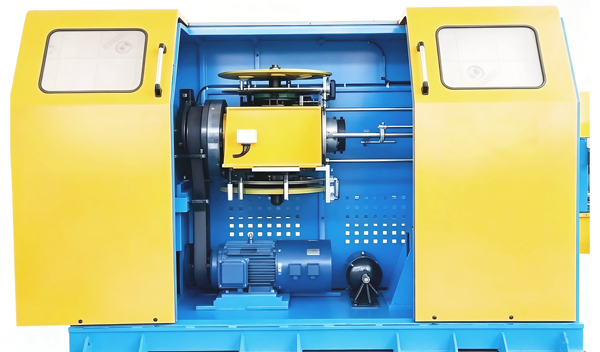
Our 1250 Cantilever Cable Laying Machine for Wire Manufacturing is designed around this practical way of thinking. We develop cable machinery for manufacturers who need stable material handling, controlled cable laying, and a Production Process that is easy to understand and manage.
At Wuxi Shuochuan Electromechanical Equipment Manufacturing Co., Ltd., we integrate research and development, manufacturing, and sales. Our product range covers high-speed extruders, automatic BV extrusion Production Lines, BVVB automated production lines, photovoltaic wire and Cable Production lines, automotive Wire Production lines, electronic Wire Production Lines, network communication wire production lines, Cable Production Lines, charging pile cable production lines, take-up and unwinding equipment, Auxiliary Equipment, and related raw materials.
Because of this wider product background, we understand that a cable laying machine is rarely working alone. It normally forms part of a complete manufacturing process.
In this page, I will explain how we understand the 1250 Cantilever Cable Laying Machine, how the laying process works, what we pay attention to during production, where the machine can be used, and what customers should consider before placing an order.
1. What Is a 1250 Cantilever Cable Laying Machine?
A 1250 Cantilever Cable Laying Machine is industrial equipment used to bring individual conductors or cable components together and lay them into a specified cable structure. It is designed for manufacturers that need controlled cable forming and stable material movement during continuous production.
The term “cantilever” refers to the structural arrangement of the machine. Instead of simply thinking about the machine as a rotating unit, we look at the complete material path, including pay-off, guiding, tension control, laying, forming, and take-up.
The “1250” in the product name is the model designation. It should not be treated as a complete statement of every working paraMeter. The actual machine configuration depends on the customer's cable construction and production requirements.
This distinction is important when buying industrial cable equipment.
For example, one customer may manufacture a power cable, while another produces an automotive cable. Even if both customers ask about a 1250 machine, their conductor arrangement and production conditions may be completely different.
We therefore normally confirm several technical points before finalizing the machine:
Finished cable type
Conductor material
Number of conductors
Conductor structure
Required cable construction
Production capacity requirements
Reel or drum dimensions
Required laying conditions
Pay-off requirements
Take-up requirements
Workshop space
Electrical and control requirements
Connection with existing production equipment
This approach helps us build a machine around the actual production task instead of simply selling a standard machine name.
What Does Cable Laying Mean?
In simple terms, cable laying is the process of bringing several wires or cable components together and arranging them into a controlled structure.
Imagine several individual wires running separately. If we simply push them together, the result will not necessarily have the shape or stability required for a finished cable. The laying machine controls their movement and combines them in a planned way.
The machine therefore has to manage three things at the same time:
The movement of the individual conductors
The rotational or laying action
The collection of the finished cable
If these three parts are not coordinated, the finished cable may become loose, uneven, or difficult to process in the next production stage.
Typical Applications
Our stranding and cable laying equipment can be considered for a variety of wire and cable manufacturing applications, including:
Power cable production
Electrical wire manufacturing
Automotive wire production
Photovoltaic cable production
Communication cable manufacturing
Charging pile cable production
Industrial cable manufacturing
Other customized cable structures
The suitable configuration depends on the actual cable specification.
2. How Does the 1250 Cantilever Cable Laying Machine Work?
The basic working principle is not difficult to understand. Individual conductors are supplied from pay-off units, guided into the working area, controlled under suitable tension, combined through the laying process, and then collected by the take-up system.
What makes the machine valuable is the way these individual actions are coordinated.
Step 1: Pay-Off
The process starts with the individual conductor reels.
Each conductor must leave its reel in a controlled way. If the material comes off too quickly, too slowly, or with unstable tension, it can influence the cable structure later in the process.
For this reason, we pay attention to the pay-off arrangement when discussing a new project. The pay-off system should match the conductor material, reel condition, production requirements, and overall machine configuration.
Step 2: Guiding
After leaving the pay-off section, the conductors travel through the guide system.
The purpose is straightforward: keep the conductors moving along the intended path.
This sounds like a small detail, but cable manufacturing often depends on many small details. If the conductor path is poorly controlled, the final laying result can become inconsistent.
Step 3: Tension Control
Tension is one of the most important factors in cable laying.
We need enough tension to keep the material controlled, but excessive tension can also cause problems. The suitable condition depends on the material and cable construction.
When we configure the machine, we consider how the pay-off, laying mechanism, and take-up system work together. We do not look at tension as a completely separate issue.
Step 4: Cable Laying
The individual conductors are brought together through the laying section.
The machine controls the relationship between material movement and the laying action. The result is a more organized cable structure that can move into the following manufacturing stage.
The exact laying process depends on the product design. This is one reason we ask customers for cable drawings or technical specifications whenever possible.
Step 5: Cable Forming
As the conductors come together, the cable takes its intended shape.
At this point, stability becomes especially important. The cable should not be forced into shape in a way that creates unnecessary stress or deformation.
Our approach is to consider the complete production path so that the laying and forming process works naturally with the cable design.
Step 6: Take-Up
Finally, the finished cable is collected onto the take-up reel or drum.
The take-up system must work together with the upstream laying process. If the take-up speed and material movement are not properly coordinated, the collection process may affect the cable structure.
That is why we normally consider the take-up arrangement when discussing the complete 1250 Cantilever Cable Laying Machine for Wire Manufacturing solution.
The simplified process can be shown as:
Pay-Off → Guiding → Tension Control → Cable Laying → Cable Forming → Take-Up → Inspection
For a new operator, this simple flow is often enough to understand the basic logic of the equipment.
3. Main Features We Focus On
When we describe the main features of a cable laying machine, we prefer to talk about things that matter on the factory floor.
A machine may look impressive in photographs, but the real test comes after installation, when operators use it every day.
Stable Material Handling
The first requirement is stable conductor movement.
Conductors need to enter the machine smoothly, pass through the guide system properly, and reach the laying section without unnecessary disturbance.
Stable material handling can make production easier to manage and can also make troubleshooting more straightforward.
Controlled Cable Laying
The purpose of the machine is to produce a controlled cable structure.
We therefore pay attention to the relationship between laying movement, conductor tension, guiding, and take-up.
These functions may look separate on a machine drawing, but they are connected during real production.
Flexible Production Configuration
Different cable products require different production conditions.
For this reason, the 1250 Cantilever Cable Laying Machine can be discussed and configured according to the customer's actual application.
Depending on the project, this may involve different pay-off arrangements, tension control methods, take-up systems, electrical controls, or auxiliary equipment.
Suitable for Continuous Production
Cable manufacturing is normally a continuous process. Stopping a production line frequently can create material waste and reduce productivity.
We therefore focus on mechanical stability, proper assembly, suitable control functions, and pre-shipment testing.
The objective is not simply to make the machine run once. We want the machine to be prepared for regular industrial operation.
Integration With Other Equipment
The machine can be used as part of a broader cable manufacturing system.
Depending on the production line, it may work with extrusion equipment, pay-off equipment, take-up equipment, unwinding equipment, inspection systems, and other auxiliary machines.
This is useful for manufacturers that are expanding an existing factory and do not want to rebuild the entire production process.
Practical Maintenance
We believe maintenance should be simple enough for production staff to understand.
Routine checks can include cleaning, checking mechanical connections, inspecting moving parts, observing abnormal noise or vibration, and following the maintenance instructions supplied with the machine.
A clear maintenance routine can help operators notice small problems before they become larger production issues.
4. Technical Considerations for Different Cable Applications
A cable laying machine may be used for many different products, but the production requirements are not the same.
This is where experience becomes useful.
Power Cable Manufacturing
Power cables can have relatively complex conductor constructions. The conductor may be solid or stranded, and the final cable may include insulation, shielding, fillers, sheathing, or other layers depending on the product.
For this type of application, conductor arrangement and production stability are important.
IEC 60228 is an international reference for conductors of insulated cables and cords. It covers conductor sizes, conductor construction, wire arrangements, and electrical resistance requirements for applicable power cable conductors.
| General Conductor Category | Basic Construction | Production Consideration |
|---|---|---|
| Solid conductor | One solid wire | Simple conductor structure where specified by the cable design |
| Stranded conductor | Multiple individual wires combined together | Requires controlled wire arrangement and suitable laying or stranding conditions |
| Copper conductor | Solid or stranded copper construction | Material characteristics, conductor size and tension conditions should be considered |
| Aluminium conductor | Solid or stranded aluminium construction | Conductor properties and required electrical characteristics need to match the product specification |
Source: IEC 60228:2023, Conductors of insulated cables. This table is a simplified production reference and does not replace the applicable cable standard or customer specification.
Automotive Wire Production
Automotive wires can have different conductor structures, insulation materials, sizes, and flexibility requirements.
For automotive wire manufacturers, stable conductor handling can be particularly important because the conductor may need to pass through several downstream processes.
We therefore consider the complete line rather than treating the laying machine as an independent piece of equipment.
Photovoltaic Cable Manufacturing
Photovoltaic cables are used in solar power systems and are normally designed according to specific application and product requirements.
When producing these cables, the manufacturer needs to maintain the specified conductor structure before the next stages of insulation and cable processing.
Our equipment configuration is therefore based on the customer's actual photovoltaic cable specification rather than assuming that every solar cable uses exactly the same process.
Communication and Electronic Cables
Communication and electronic cables can involve smaller conductors and different construction methods.
For these applications, the machine configuration needs to match the product size and production process. Material handling, tension, guiding, and take-up conditions should all be considered.
Charging Cable Production
Charging cables are another application where cable structure and production requirements need to be clearly defined.
Depending on the cable design, different conductors and internal components may need to be combined before downstream insulation and sheathing processes.
We can discuss the machine configuration based on the actual charging cable structure and production requirements.
5. Safety, Electrical Design, and Production Reliability
When industrial machinery is used every day, safety cannot be treated as a decorative feature.
There are rotating parts, moving materials, electrical systems, and stored mechanical energy. The machine therefore needs appropriate protective measures based on its actual risks.
ISO 12100 provides a general framework for machinery safety, including risk assessment and risk reduction. It is useful as a reference when identifying machine hazards and deciding on suitable protective measures.
For machine electrical systems, IEC 60204-1 covers electrical equipment of machines and includes areas such as protective bonding, emergency stop functions, control circuits, overcurrent protection, and technical documentation.
| Reference | Area Covered | Why It Matters |
|---|---|---|
| ISO 12100 | Machinery safety and risk reduction | Provides a structured approach to identifying hazards and reducing machine-related risks. |
| IEC 60204-1 | Electrical equipment of machinery | Addresses important electrical and control-system safety considerations. |
| IEC 60228:2023 | Conductors for applicable insulated cables | Provides technical reference information for conductor construction and electrical characteristics. |
Source: International Organization for Standardization (ISO) and International Electrotechnical Commission (IEC) publications. These standards are technical references; actual conformity requirements depend on the machine, destination market, cable product, and applicable regulations.
For our own machine projects, we also pay attention to practical operator use. Controls should be understandable, important functions should be checked during commissioning, and the machine should be inspected before shipment according to the agreed technical requirements.
We do not claim that simply mentioning a standard means a machine automatically complies with every requirement. Compliance needs to be assessed according to the actual machine and applicable market requirements.
6. How We Manufacture and Prepare the Machine for Delivery
One of the questions customers often ask is: “What happens after we place the order?”
For a large industrial machine, the answer involves several stages.
Technical Review
We first confirm the technical requirements.
This includes the cable structure, conductor information, production requirements, machine configuration, reel conditions, workshop limitations, control requirements, and other agreed details.
This stage is important because a clear technical agreement gives the manufacturing team a reliable target.
Component Preparation and Mechanical Manufacturing
After the technical requirements are confirmed, the required components are prepared and the machine structure is manufactured and assembled.
Mechanical accuracy matters because the machine contains moving and rotating parts. Alignment, fastening, transmission components, guides, supports, and related assemblies need to be checked during production.
Electrical Installation
The electrical and control components are installed according to the agreed configuration.
Depending on the project, this can include control cabinets, sensors, motors, control circuits, protective functions, and connections for related equipment.
For customers who plan to connect the machine to an existing production line, we recommend confirming the interface requirements before manufacturing begins.
Assembly and Testing
Before delivery, we assemble, inspect, test, and check each machine according to the agreed technical requirements.
This is an important part of our production process.
A machine that looks complete is not necessarily ready for shipment. We need to check whether the mechanical components work properly, whether the electrical system operates as expected, and whether the control functions respond correctly.
Testing also gives us an opportunity to identify issues before the equipment reaches the customer's factory.
Production and Delivery Time
For our Stranding Machine Series, the typical production and delivery cycle is generally 30–90 days after technical specifications and order details have been confirmed.
This is a general project range rather than a guaranteed fixed delivery date.
The actual schedule can change depending on the machine model, cable structure, customization requirements, production workload, component availability, inspection arrangements, and shipping plan.
| Stage | Main Work | Typical Customer Requirement |
|---|---|---|
| Technical confirmation | Confirm cable structure and machine requirements | Provide accurate cable specifications and production information |
| Machine manufacturing | Component preparation and mechanical assembly | Confirm agreed technical configuration |
| Electrical installation | Control and electrical system installation | Confirm power and control requirements |
| Inspection and testing | Machine assembly, inspection and operation checks | Review agreed technical requirements |
| Packaging | Protect major components for transportation | Confirm destination and shipping conditions |
| Shipment | Arrange suitable transportation | Prepare receiving and installation conditions |
Source: Wuxi Shuochuan Electromechanical Equipment Manufacturing Co., Ltd. product and project information supplied for this product page. Actual production and delivery time should be confirmed for each individual order.
Packaging for Transportation
Large machinery has to deal with another challenge after leaving the factory: transportation.
During shipping, equipment can be exposed to moisture, dust, impact, vibration, and movement. We therefore protect major components according to their structure and shipping conditions.
Depending on the project, packaging may include steel frames, wooden cases, protective films, and other suitable materials.
The final packaging method is selected according to the machine structure, transportation method, destination, and logistics requirements.
7. Payment, Transportation, and International Project Support
Buying a cable production machine is usually a project rather than a simple product purchase. The commercial process needs to be clear from the beginning.
Payment Terms
Payment terms are arranged according to the contract.
A common arrangement is a deposit followed by the balance before shipment. Other payment arrangements may also be discussed and agreed according to the specific project.
We recommend that technical specifications, delivery conditions, payment terms, inspection requirements, and other important commercial details are clearly included in the final agreement.
Transportation
For international customers, transportation can be arranged by sea, rail, or other suitable methods depending on the destination and machine dimensions.
The choice of transportation method depends on several factors:
Destination country and location
Machine dimensions
Total shipment weight
Required delivery time
Port or railway conditions
Customer logistics arrangements
Because large industrial equipment can have unusual dimensions, transportation planning should be discussed before final packaging.
Installation Preparation
Customers should also prepare the receiving area before the machine arrives.
Depending on the final machine configuration, this may include sufficient floor space, electrical power, lifting equipment, access for transportation, cable production materials, and suitable operators or technicians.
Good preparation can make installation and commissioning much smoother.
8. Why Work With Wuxi Shuochuan?
There are many cable machinery suppliers in the market. We know customers have plenty of choices.
So why should a manufacturer talk with us about a 1250 Cantilever Cable Laying Machine for Wire Manufacturing?
We Develop More Than One Type of Cable Equipment
Our experience is not limited to one machine category.
Our main products include high-speed extruders, three-in-one BV extrusion automatic production lines, three-in-one plus one BVVB automated production lines, photovoltaic wire and cable production lines, automotive wire production lines, electronic wire production lines, network communication wire production lines, cable production lines, charging pile cable production lines, take-up and unwinding series, auxiliary equipment, and raw materials.
This gives us a broader view of cable production.
We understand that one machine often affects the next machine. Material handling, production speed, tension, take-up, and line layout all need to work together.
We Have R&D and Manufacturing Capability
Wuxi Shuochuan Electromechanical Equipment Manufacturing Co., Ltd. integrates R&D, manufacturing, and sales.
We have obtained more than ten utility model patent certificates, reflecting our ongoing work in equipment development and improvement.
We also operate under the quality management approach described in our company information, with ISO 19001 quality management system certification covering the process from R&D through production.
For us, certification and patents are not the final purpose. The more important question is whether the equipment works properly for the customer.
We Prefer Clear Technical Communication
Industrial equipment projects can become complicated very quickly when technical information is unclear.
We therefore encourage customers to provide cable drawings, product specifications, production targets, reel information, and other useful details.
If something is not suitable, it is better to explain it before the order is confirmed.
We Build Around Actual Requirements
We do not believe every manufacturer needs exactly the same machine configuration.
A cable manufacturer with an existing production line may need a different solution from a customer building a new factory. A manufacturer producing power cables may have different requirements from one producing automotive wires.
Our job is to understand those differences and configure the equipment accordingly.
Our Working Philosophy
Our corporate spirit is “Quality First, Continuous Improvement, and Honest Service.”
Our long-term goal is to create useful products and keep customers satisfied.
In practical terms, this means we care about technical details, production quality, machine testing, delivery preparation, and communication throughout the project.
9. Frequently Asked Questions About the 1250 Cantilever Cable Laying Machine
Q1: What is the main purpose of the 1250 Cantilever Cable Laying Machine?
The machine is designed for cable laying and cable forming applications in wire and cable manufacturing. It brings individual conductors or cable components together into a controlled structure for subsequent production processes.
Q2: What types of cables can it be used for?
Depending on the machine configuration, it can be considered for power cables, electrical wires, communication cables, automotive wires, photovoltaic cables, charging pile cables, industrial cables, and other cable products.
Q3: Is the 1250 model suitable for every cable?
No. The model number alone does not determine whether the machine is suitable for a particular cable. We need to review the cable structure, conductor material, number of conductors, production requirements, reel conditions, tension requirements, and other technical information before confirming suitability.
Q4: Can you customize the machine?
Yes. We can discuss customized configurations according to cable structure, production requirements, workshop layout, reel conditions, pay-off requirements, take-up requirements, control requirements, and auxiliary equipment.
Q5: What information should I send when requesting a quotation?
The most useful information includes the cable drawing, conductor material, conductor construction, number of conductors, cable structure, expected production requirements, reel size, required production speed if available, power supply information, workshop limitations, and any special automation requirements.
A product drawing is especially useful because it allows us to understand the actual cable rather than making assumptions from a product name.
Q6: How long is the production and delivery period?
The typical production and delivery cycle for our Stranding Machine Series is generally 30–90 days after technical specifications and order details are confirmed. The actual lead time depends on the machine model, customization requirements, production schedule, components, testing, and shipping conditions.
Q7: What payment terms are available?
Payment terms are arranged according to the contract. A common arrangement is a deposit with the balance paid before shipment. Other mutually agreed arrangements can also be discussed.
Q8: How is the machine shipped?
The machine can be shipped by sea, rail, or other suitable transportation methods depending on the destination, machine dimensions, delivery requirements, and logistics conditions.
Q9: How do you protect the machine during transportation?
We protect major components against moisture, dust, impact, and movement. Depending on the machine structure and shipping conditions, we may use steel frames, wooden cases, protective films, and other suitable packaging materials.
Q10: Do you test the machine before shipment?
Yes. Before delivery, we assemble, inspect, test, and check the machine according to the agreed technical requirements. This helps us identify potential mechanical, electrical, or control issues before the machine leaves our facility.
Q11: Can the machine be integrated into an existing cable production line?
Depending on the application, yes. We can discuss integration with pay-off equipment, extrusion equipment, take-up systems, unwinding equipment, and other auxiliary machinery. The interface and control requirements should be confirmed during the technical review.
Q12: Is a cable drawing necessary before ordering?
It is strongly recommended. A cable drawing gives us useful information about the conductor arrangement and final structure. It helps our technical team understand the production requirements and reduces the chance of misunderstanding during configuration.
Q13: What should I consider when choosing a cable laying machine?
Start with the cable rather than the machine model. Consider conductor material, cable construction, number of conductors, production target, reel dimensions, tension requirements, workshop space, downstream equipment, and automation requirements.
Q14: What makes a cable laying machine reliable in everyday production?
In our view, reliability comes from many practical details working together. Mechanical assembly, material guiding, suitable tension control, stable laying, take-up coordination, electrical control, routine maintenance, and proper pre-shipment testing all contribute to dependable operation.
Final Thoughts: A Cable Machine Should Work in the Real Factory
We believe a good 1250 Cantilever Cable Laying Machine for Wire Manufacturing should do more than look good in a catalogue.
It needs to fit the customer's cable structure.
It needs to handle materials in a controlled way.
It needs to work with the production line around it.
It needs to be understandable to operators.
And before it is shipped, it needs to be assembled, inspected, tested, and checked against the agreed technical requirements.
That is the approach we take at Wuxi Shuochuan Electromechanical Equipment Manufacturing Co., Ltd.
Our experience in extruders, cable production lines, photovoltaic wire and cable equipment, automotive wire production equipment, electronic wire production equipment, communication cable equipment, take-up and unwinding systems, and auxiliary machinery gives us a wider understanding of wire and cable manufacturing.
When a customer contacts us about a 1250 Cantilever Cable Laying Machine, we do not want to guess what they need. We prefer to understand the product first, then discuss the machine configuration.
For customers producing power cables, electrical wires, photovoltaic cables, automotive wires, communication cables, charging cables, or other customized products, this practical approach can make the equipment selection process much clearer.
The typical production and delivery cycle is generally 30–90 days after technical specifications and order details are confirmed. Payment, transportation, packaging, and other commercial conditions can be arranged according to the individual contract.
If you are planning a new wire manufacturing project, expanding an existing cable production line, or replacing older cable laying equipment, we welcome you to share your cable drawing, production requirements, and workshop information with us.
We will review the application and discuss a suitable equipment configuration based on the actual production conditions.
Quality First, Continuous Improvement, and Honest Service is more than a phrase we use. It describes how we want to work with customers throughout the equipment project.
For us, the final measure of a 1250 Cantilever Cable Laying Machine for Wire Manufacturing is simple: whether it can become a useful, stable, and practical part of the customer's real production process.



 WhatsApp
 телефон