


 English
 中文
中文

When we talk about wire and Cable Production, wrapping is one of those processes that looks simple from the outside but needs careful control in actual production. The material has to move steadily, the cable needs to stay in the correct position, and the wrapping process needs to remain consistent over a long production run.
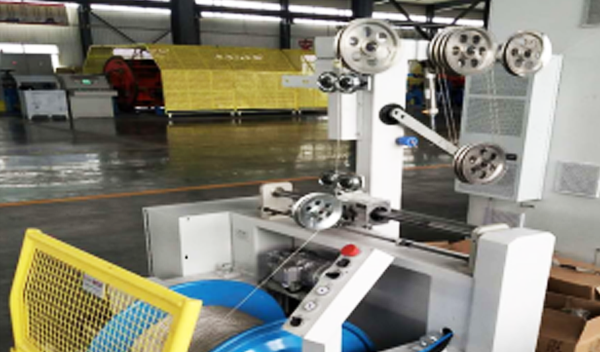
Our Φ630 Double Layer Wrapping Machine is designed for continuous wrapping applications in wire and cable manufacturing. The machine uses a double-layer wrapping structure to support continuous material application around the cable. We can configure the equipment according to the customer's cable structure, wrapping material, production requirements, and working conditions.
At Wuxi Shuochuan Electromechanical Equipment Manufacturing Co., Ltd., we manufacture equipment for wire and cable production. Our product range covers high-speed extruders, Automatic Extrusion Production Lines, photovoltaic wire and Cable Production Lines, automotive Wire Production lines, electronic Wire Production Lines, communication cable Production Lines, charging pile cable production lines, take-up and unwinding equipment, wrapping equipment, and other Auxiliary Equipment.
For us, a wrapping machine is not an isolated piece of equipment. It needs to fit into the customer's complete Production Process. That is why we normally discuss the cable structure and material before confirming the final configuration.
1. What Is the Φ630 Double Layer Wrapping Machine?
In simple terms, our Φ630 Double Layer Wrapping Machine is a Cable Wrapping Machine designed to apply wrapping materials in a continuous production process. The double-layer arrangement allows the machine to handle two wrapping layers within the designed production structure.
The actual wrapping material can vary from one cable application to another. Depending on the product design, manufacturers may use different Non-metallic Wrapping materials for insulation, separation, protection, filling, or other cable construction purposes.
We do not recommend choosing a machine only because the product name looks suitable. The wrapping material, cable structure, required overlap, production speed, and connection with other equipment all affect the final configuration.
The term Φ630 is part of the product designation. We do not use it to make assumptions about a cable diaMeter or another parameter that has not been confirmed by the customer.
Why use two wrapping layers?
Different cable designs require different layers. In some production processes, one wrapping layer may not meet the required structure, so a second layer is added.
A double-layer wrapping machine gives manufacturers a practical way to carry out two wrapping operations within one equipment arrangement. This can help simplify the production layout compared with treating every wrapping operation as a completely separate process.
However, the actual purpose of each layer depends on the cable design. One layer may have a different material or wrapping requirement from the other. We therefore confirm the customer's material and cable construction before deciding how the machine should be configured.
| Cable Production Factor | Why It Matters | Our Approach |
|---|---|---|
| Cable structure | Different cable designs require different wrapping arrangements | Confirm the actual cable construction before configuration |
| Wrapping material | Material properties affect feeding and wrapping | Select the machine configuration according to the material |
| Number of layers | Different products may require different insulation or protection layers | Use a double-layer arrangement where the production process requires it |
| Production conditions | Continuous cable production needs stable material movement | Configure the machine around the customer's working conditions |
Industry reference: IEC 60502-1 specifies construction, dimensions, and test requirements for certain power cables with extruded solid insulation. The standard shows that cable construction is made up of defined elements rather than being a single material layer.
2. How Does a Double Layer Wrapping Machine Work?
The working principle is quite easy to understand. The cable moves through the machine, while wrapping materials are fed from their respective material supply positions. The wrapping system guides the material around the cable and keeps the production movement stable.
Because our machine uses a double-layer wrapping arrangement, the production process needs to coordinate the movement of the cable and the two wrapping paths.
Step 1: Cable feeding
The cable or cable core enters the machine from the upstream production equipment. The feeding path needs to remain stable so the wrapping material can follow the cable correctly.
If the cable moves from side to side or changes position unexpectedly, the wrapping result can also change. So, cable alignment is a basic but important part of the whole process.
Step 2: First wrapping layer
The first wrapping material is fed into the first wrapping section. The material moves around the cable according to the machine configuration.
At this stage, material tension and feeding stability are important. If the material is too loose, the wrapping may not remain consistent. If it is pulled too strongly, the material may be damaged or the wrapping condition may change.
Step 3: Second wrapping layer
The second wrapping layer follows the first layer according to the designed production arrangement.
The purpose of the second layer depends on the cable structure. It may provide another insulation layer, separation layer, protection layer, or another function required by the cable design.
Step 4: Continuous movement
The machine keeps the cable and wrapping materials moving continuously. This is important because most industrial cable production is based on long continuous lengths rather than individual short pieces.
Our design focus is therefore not only on how the machine starts. We also care about how it behaves during continuous operation.
Step 5: Connection with downstream equipment
After wrapping, the cable can continue to the next stage of the production line. Depending on the customer's complete process, this may involve additional insulation, sheathing, testing, take-up, or other cable processing equipment.
This is why we normally discuss the machine together with the upstream and downstream process when working on a complete production project.
3. Main Features of the Φ630 Double Layer Wrapping Machine
Double-layer wrapping structure
The most obvious feature is the double-layer arrangement. It is designed for cable production processes where two wrapping layers are required.
Instead of using a completely separate machine for every wrapping step, a double-layer structure can make the production arrangement more compact and easier to manage, depending on the customer's process.
Continuous wrapping
Our machine is designed around continuous wire and cable production. This means the cable can keep moving through the wrapping process instead of requiring repeated manual positioning.
Continuous processing is particularly useful for cable manufacturers producing long lengths of wire and cable.
Flexible material configuration
We understand that wrapping materials are not identical. Different cable manufacturers may use different tapes, films, papers, or other non-metallic materials according to their product structure.
For this reason, we discuss the actual wrapping material before confirming the equipment configuration.
Stable material handling
Material handling is one of the areas we pay close attention to. A wrapping material needs to travel along a controlled path before it reaches the cable.
This becomes even more important when the material is thin or flexible. Small changes in material tension can affect the final wrapping condition.
Practical operation
We prefer straightforward industrial equipment. Operators should be able to understand the basic production process without having to deal with unnecessary complexity.
Our goal is to make the equipment practical for everyday factory use, not just impressive on a specification sheet.
Suitable for production line integration
The Φ630 Double Layer Wrapping Machine can be considered as part of a wider cable manufacturing system. Depending on the project, it can work together with extrusion equipment, take-up equipment, unwinding equipment, and other cable production machines.
4. Technical Advantages: Why Wrapping Control Matters
When customers ask us about the technical advantages of a wrapping machine, we usually start with the production process rather than a list of complicated terms.
A good wrapping process should be stable, repeatable, and easy to monitor.
Material tension
Wrapping material needs controlled tension. Too much tension can put unnecessary stress on the material. Too little tension can make the material difficult to control.
The correct condition depends on the material itself and the cable production process. That is why we do not use one fixed tension value for every application.
Material alignment
The material needs to arrive at the wrapping point in the correct position. If the material moves sideways, the overlap or coverage can change.
In a double-layer system, alignment becomes even more important because the two wrapping layers need to work together with the cable structure.
Wrapping consistency
Consistency is one of the main goals of industrial cable production. The first few meters may look good, but that is not enough. The same production condition needs to be maintained over a long cable length.
We therefore focus on mechanical stability and controlled material movement rather than simply chasing a high operating speed.
Relationship between wrapping and cable construction
A wrapping machine cannot be evaluated separately from the cable design. The conductor, insulation, shielding, filling, wrapping, and sheath may all be part of one complete cable structure.
IEC 60228:2023, for example, specifies nominal conductor cross-sectional areas from 0.5 mm² to 3,500 mm² for a wide range of electric power cables and cords and includes requirements related to conductor wire numbers, sizes, and resistance values.
This does not mean every cable using our wrapping machine follows IEC 60228. It simply shows why the cable structure needs to be clearly understood before selecting production equipment.
| Technical Area | Production Concern | Practical Result |
|---|---|---|
| Material tension | Material should move without excessive pulling or slack | More stable wrapping conditions |
| Material alignment | Wrapping material should follow the intended path | More consistent layer placement |
| Cable alignment | Cable should remain stable through the wrapping section | Better coordination between cable and wrapping material |
| Layer coordination | Two wrapping layers need to work within the same production process | Suitable double-layer processing |
| Continuous operation | Machine needs to remain stable during long production runs | More practical continuous manufacturing |
Source: IEC 60228:2023, IEC 60502-1:2021, and general cable manufacturing principles.
Insulation thickness is also a measurable quality point
Wrapping is only one part of Cable Quality control, but the final insulation structure still needs to be checked according to the applicable cable specification.
IEC 60811-201:2012, with its later amendments, provides methods for measuring insulation thickness for common insulating compounds such as cross-linked materials, PVC, PE, and PP.
For us, this reinforces an important idea: production equipment and quality inspection need to be considered together. A wrapping machine helps create the cable structure, while testing and inspection help confirm whether the finished product meets the required specification.
5. What Materials and Cables Can Be Used?
Our Φ630 Double Layer Wrapping Machine is mainly intended for wire and cable wrapping processes. The exact material choice depends on the customer's product.
Non-metallic wrapping materials
Non-metallic wrapping materials can be selected for different insulation, separation, protection, or cable structure requirements.
Possible materials may include suitable films, tapes, papers, and other non-metallic materials, depending on the production application. We do not assume that every material can run under the same machine settings.
Electrical wires
Electrical wire production can use wrapping equipment when the product structure requires a wrapped insulation or protection layer.
The exact production arrangement depends on the wire construction and the material being applied.
Power cables
Power cables can contain multiple layers with different functions. IEC 60502-1:2021 covers construction, dimensions, and test requirements for certain power cables with extruded solid insulation at rated voltages of 1 kV and 3 kV.
Our machine is not limited to one particular cable standard. Instead, we configure the wrapping equipment according to the customer's actual cable structure.
Automotive wires
Automotive wire production is another potential application. The equipment can be considered when a cable structure requires continuous wrapping or insulation-related processing.
Automotive products can have strict production requirements, so we recommend confirming the material, cable structure, and working conditions before equipment selection.
Photovoltaic cables
Photovoltaic wire and cable are an important part of our wider cable equipment business. Depending on the cable design, wrapping equipment can be integrated into the manufacturing process.
Communication cables
Communication cables may have different construction requirements from power cables. We therefore treat communication cable projects separately rather than assuming that one standard machine configuration fits every application.
Electronic wires
Electronic wire production often involves smaller and more delicate cable structures. Stable material handling is useful when the wrapping material needs to remain in a controlled position during continuous production.
Charging cables
Charging pile cables and related charging cables are also within our broader wire and cable equipment applications. The actual wrapping requirements depend on the cable design and insulation system.
| Application | Typical Production Requirement | Possible Wrapping Role |
|---|---|---|
| Electrical wire | Continuous insulation and cable processing | Wrapping, separation, or protection |
| Power cable | Multi-layer cable construction | Specified wrapping layer according to cable design |
| Automotive wire | Repeatable continuous processing | Insulation or protective wrapping where required |
| Photovoltaic cable | Continuous cable production | Wrapping within the agreed cable structure |
| Communication cable | Controlled handling of cable components | Material wrapping according to product design |
| Electronic wire | Stable processing of smaller wire structures | Insulation-related wrapping |
| Charging cable | Continuous production of specialized cable structures | Wrapping according to the agreed cable design |
Reference: IEC 60502-1 addresses defined power cable construction and testing requirements, while IEC 60228 addresses conductor dimensions and resistance requirements for applicable power cables and cords.
6. Manufacturing Process, Inspection, Delivery, and Packaging
When we manufacture a cable wrapping machine, we do not start by simply putting components together. We first need to understand what the machine is expected to do.
Technical confirmation
The first step is technical communication with the customer. We discuss the cable type, wrapping material, cable structure, production requirements, working conditions, and related equipment.
This information helps us determine the appropriate equipment configuration.
Machine design and component preparation
After the technical requirements are confirmed, we arrange the machine design and component preparation. Mechanical components, electrical components, control elements, and other parts are prepared according to the agreed equipment configuration.
Mechanical assembly
The main mechanical parts are assembled in the workshop. We check the structure and make the necessary adjustments during assembly.
For a wrapping machine, mechanical alignment matters because the material path and cable path need to work together.
Electrical installation
The electrical control system is installed and connected according to the equipment design. We then check the control functions and machine movement.
Testing
Before shipment, each machine is assembled, inspected, and tested according to the agreed technical requirements.
We check the general operating condition of the equipment and make adjustments where required.
Production schedule
After the technical specifications and order details are confirmed, our typical production and delivery cycle is around 30–90 days.
The actual schedule can vary according to the equipment configuration, project requirements, component availability, and other practical factors.
Payment
Payment terms can be arranged according to the contract. A common arrangement is a deposit followed by the balance before shipment, although other mutually agreed arrangements can also be discussed.
Transportation
We can arrange sea freight, rail transportation, or other suitable transportation methods according to the destination and equipment dimensions.
Packaging
For packaging, we normally use protective film, steel frames, wooden cases, or other suitable materials.
The purpose is straightforward. We want to reduce the risk of moisture, dust, impact, and unwanted movement during transportation.
| Stage | Our Work | Purpose |
|---|---|---|
| Technical discussion | Review cable structure and wrapping requirements | Confirm the right equipment configuration |
| Manufacturing | Machine and assemble equipment | Build the agreed machine structure |
| Electrical integration | Install and check control components | Support normal machine operation |
| Inspection and testing | Run and check the equipment | Verify agreed technical requirements |
| Packaging | Use protective materials and suitable packing structures | Protect the machine during transportation |
| Delivery | Arrange suitable transportation | Move the equipment safely to the destination |
7. Why Choose Wuxi Shuochuan for Cable Wrapping Equipment?
We know that buying an industrial machine is different from buying a standard consumer product. The customer is not simply buying a box. The machine needs to become part of a production process and work for a long time.
We understand the cable production process
Our company focuses on wire and cable production equipment. Our product range includes extruders, automatic extrusion lines, photovoltaic cable production lines, automotive wire production lines, electronic wire production lines, communication cable production lines, charging cable production lines, take-up equipment, unwinding equipment, wrapping equipment, and auxiliary equipment.
Because of this product range, we can look at a wrapping machine from the perspective of the complete production line.
We focus on practical machine design
We believe factory equipment should be practical. Operators need to understand the production process. Maintenance workers need to be able to inspect the machine. Production managers need to be able to understand what the machine is doing.
We therefore try to avoid unnecessary complexity when it does not provide real production value.
We support customized configurations
One customer may produce electrical wire. Another may produce photovoltaic cable. Another may produce automotive wire or charging cable.
The cable structure and wrapping material can be different, so the equipment should not be treated as a completely fixed product.
We discuss the application first and then confirm the configuration.
We have experience across several cable equipment categories
Our equipment portfolio allows us to understand the relationship between wrapping, extrusion, take-up, unwinding, and other cable production processes.
This can be useful when the customer needs more than one type of machine or wants to integrate the wrapping machine into an existing production line.
We follow a clear quality approach
Wuxi Shuochuan Electromechanical Equipment Manufacturing Co., Ltd. integrates R&D, manufacturing, and sales. According to our company information, we have obtained more than ten utility model patent certificates and passed ISO 19001 quality management system certification.
Our corporate spirit is “Quality First, Continuous Improvement, and Honest Service.”
We try to apply this idea throughout the project, from technical communication and machine manufacturing to inspection, delivery, and customer support.
We care about the machine after it leaves our factory
A machine that works well in the workshop but does not match the customer's factory conditions is not a successful project.
That is why technical communication before manufacturing is important to us. We want to understand the customer's production environment before we finalize the machine.
8. Frequently Asked Questions About the Φ630 Double Layer Wrapping Machine
What is the Φ630 Double Layer Wrapping Machine used for?
It is designed for continuous wrapping applications in wire and cable production. The double-layer structure is intended for cable processes that require two wrapping layers according to the product design.
What does Φ630 mean?
Φ630 is part of the product designation. We do not assume that it represents a specific cable diameter, wrapping diameter, or another technical parameter unless that parameter has been confirmed in the customer's technical specification.
Can the machine use different wrapping materials?
The equipment can be configured according to suitable wrapping materials and the customer's production requirements. Because different materials have different physical properties, we recommend confirming the exact material before final equipment configuration.
Can one machine handle two wrapping layers?
Yes. The product is designed as a double-layer wrapping machine. The actual arrangement of the two layers depends on the customer's cable structure and production process.
Can it be used for non-metallic wrapping?
Yes. Our wider non-metallic wrapping equipment range is designed for continuous wrapping and insulation processes. Suitable films, tapes, papers, and other non-metallic materials can be considered according to the cable design and production requirements.
What types of cable can use this machine?
Potential applications include electrical wires, power cables, communication cables, automotive wires, photovoltaic cables, electronic wires, charging cables, and other cable products where a suitable wrapping process is required.
Can you customize the machine?
Yes. We can discuss the configuration according to the cable structure, wrapping material, production requirements, and working conditions.
How long is the production and delivery period?
Our typical production and delivery cycle is around 30–90 days after technical specifications and order details are confirmed. The actual schedule depends on the specific project.
How do you inspect the machine before delivery?
Before shipment, we assemble, inspect, and test the machine according to the agreed technical requirements. We also make necessary adjustments before packaging and transportation.
What payment terms do you accept?
Payment terms can be arranged according to the contract. A common arrangement is a deposit and balance before shipment, but the final terms can be mutually agreed upon.
How is the machine packaged?
We normally use protective film, steel frames, wooden cases, or other suitable packaging materials. The packaging method depends on the equipment structure, dimensions, destination, and transportation requirements.
How can the machine be transported?
We can arrange sea freight, rail transportation, or other suitable methods according to the destination and equipment dimensions.
What information should I send when requesting a quotation?
We recommend providing the cable type, cable structure, wrapping material, number of wrapping layers, production requirements, and available production line information. If you have product drawings or technical documents, these can also help us understand the application more accurately.
Conclusion: A Practical Double Layer Wrapping Solution
Our Φ630 Double Layer Wrapping Machine is designed for one clear purpose: to provide a stable and practical solution for continuous double-layer wrapping in wire and cable manufacturing.
The machine focuses on controlled material handling, continuous cable movement, double-layer processing, and flexible configuration. Instead of assuming that every cable production project is the same, we look at the actual cable structure and wrapping requirements before confirming the equipment.
This approach is important because cable production involves many different materials and structures. IEC standards such as IEC 60228, IEC 60502-1, and IEC 60811 cover different parts of cable construction, conductor requirements, and test methods. These standards also show why production equipment should be matched to the actual cable product rather than selected only by a general product name.
At Wuxi Shuochuan, we can provide equipment for electrical wires, power cables, photovoltaic cables, automotive wires, electronic wires, communication cables, charging cables, and other wire and cable applications.
We also understand that the wrapping machine is only one part of the complete manufacturing process. Extrusion, wrapping, take-up, unwinding, testing, and other processes may all need to work together.
That is why we focus on technical communication before manufacturing. Once the technical specifications and order details are confirmed, our typical production and delivery cycle is around 30–90 days. Before shipment, we assemble, inspect, and test the equipment according to the agreed requirements.
For us, good industrial equipment does not need to be difficult to understand. It needs to work steadily, fit the production process, and make sense to the people who use it every day.
Technical References
IEC 60228:2023 — Conductors of insulated cables. The standard covers nominal conductor cross-sectional areas from 0.5 mm² to 3,500 mm² and includes requirements related to conductor wire numbers, sizes, and resistance values for applicable electric power cables and cords.
IEC 60502-1:2021 — Power cables with extruded insulation and their accessories. The standard specifies construction, dimensions, and test requirements for certain power cables with extruded solid insulation, including cables rated for 1 kV and 3 kV applications.
IEC 60811-201:2012 + amendments — Measurement of insulation thickness. This standard provides methods for measuring insulation thickness applicable to common insulating compounds including cross-linked materials, PVC, PE, and PP.
IEC 60811-202:2012 + amendments — Measurement of non-metallic sheath thickness. This standard provides methods for measuring the thickness of non-metallic cable sheaths made from common compounds such as cross-linked materials, PVC, PE, and PP.



 WhatsApp
 телефон